Why children learn values through stories, not lectures
Ask any early childhood educator what the most powerful teaching tool in their classroom is, and most will say the same thing: a good story. Not a worksheet. Not a reward chart. Not a moral lesson delivered at eye level. A story.
There's a reason for this. Young children — especially those aged 3 to 6 — are still developing the cognitive capacity for abstract thought. Concepts like "kindness," "fairness," or "empathy" are invisible. You can't point to them. You can't hold them. But you can watch a lion and a mouse become friends, and understand — in your bones — what it means to be helped by someone smaller than you ever expected.
This is the genius of narrative: story makes the invisible visible. It turns values into images, feelings, and moments that a three-year-old can hold in their mind long after the book is closed.
The science behind story and empathy
Researchers at Princeton University found that when we listen to a story, our brains synchronise with the storyteller's. The neural patterns of the listener begin to mirror those of the speaker — a process called "neural coupling." In children, this effect is even more pronounced.
When a child hears a story about a character who is lonely, their brain activates the same emotional circuits as if they themselves were lonely. This is not metaphor. It is biology. Stories build empathy literally, at the level of neural wiring.
For children aged 3 to 6, who are right in the heart of what developmental psychologists call the "sensitive period" for social-emotional learning, this matters enormously. The habits of the heart — noticing others, pausing before reacting, choosing to help — are laid down in these early years. And story is one of the most reliable ways to lay them.
"Children do not learn kindness by being told to be kind. They learn it by feeling the ache of a character's loneliness, the warmth of a stranger's generosity, the quiet satisfaction of a small act that changed someone's day."
— Mem Fox, award-winning Australian picture book author
What kinds of stories build the most kindness?
Not all stories are equal when it comes to building kindness. Research on narrative and character development suggests that the most effective stories for young children share a few key qualities:
- A relatable main character — ideally a child or animal close in age or experience to your listener. Children empathise most easily with characters who resemble them.
- A moment of choice — a point in the story where the character decides whether or not to be kind. This moment is crucial. It teaches children that kindness is a decision, not just a feeling.
- Consequences that matter — not punishment, but natural outcomes. When the character chooses kindness, something good happens — not because they earned a reward, but because the world shifted slightly for the better.
- Emotional honesty — stories that acknowledge the difficulty of being kind (it's sometimes hard, sometimes scary, sometimes costly) are more powerful than those that make it look effortless.
Bilingual stories carry an additional gift: they allow children to encounter kindness in two emotional registers. In Singapore, many families move between English and Mandarin at home. When a child hears a kindness story in Chinese — in the cadences and vocabulary that belong to a grandparent's voice — it reaches a different, deeper part of the self.
Storytelling as a family practice
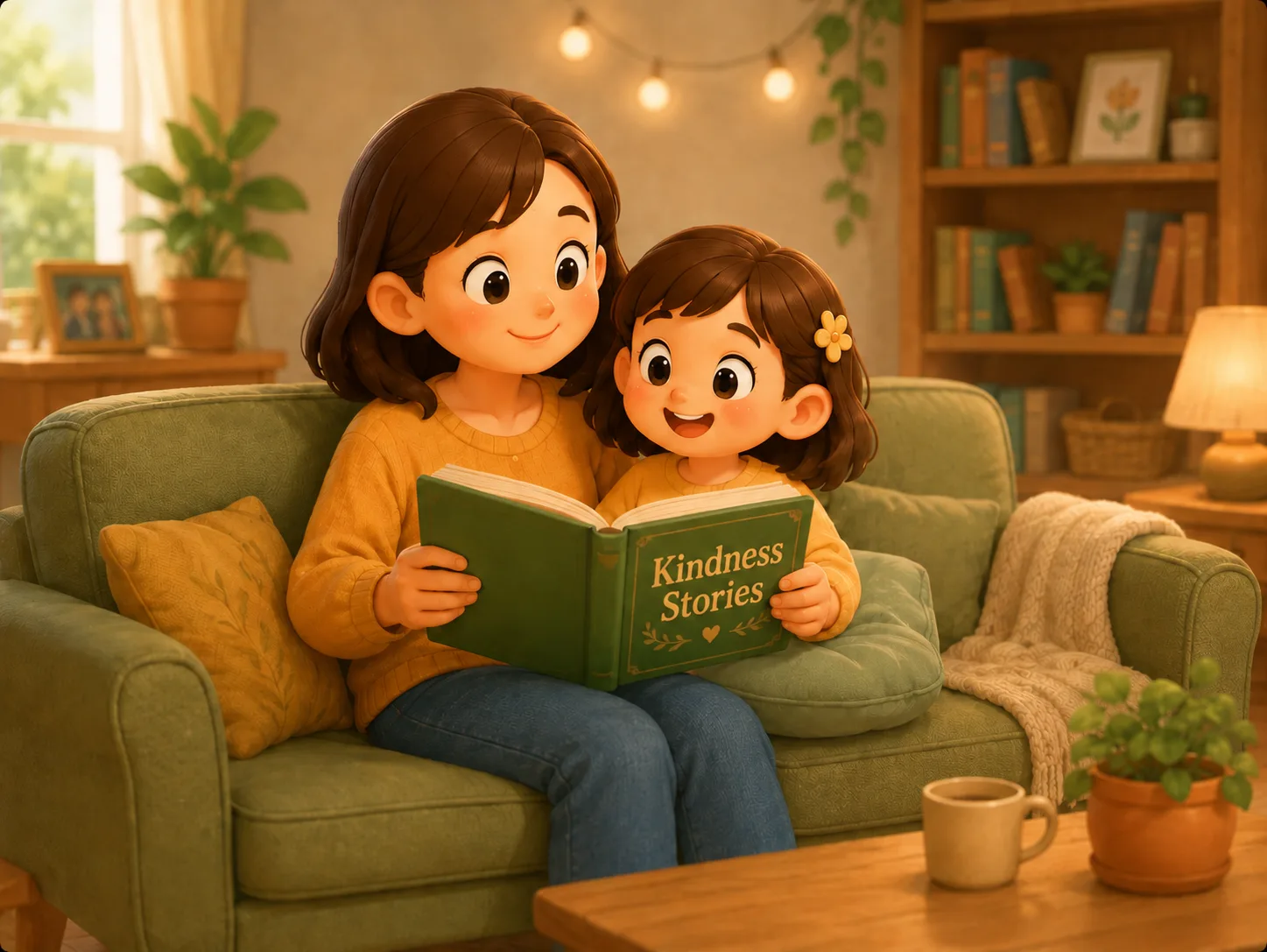
The most powerful storytelling doesn't happen in classrooms or auditoriums. It happens in kitchens, at bedtime, on bus journeys. Whenever a parent or grandparent says, "Let me tell you about the time…"
Family stories — about a grandmother's kindness during a difficult year, about a father who shared his lunch with a stranger, about a cousin who stood up for a friend — are among the most formative moral experiences a child can have. They say: this is who we are. This is what people like us do.
💡 Try this tonight: Before bed, tell your child one small true story about a time you chose to be kind — even if it was hard, even if no one noticed. Keep it simple. Keep it real. Watch what it does.
Practical tips for storytelling with young children
You don't need to be a performer to tell a good story to a child. Here's what works:
- Start with "One day…" — the simplest story opener in the world still works. Even a two-sentence story about a bird who shared a worm is enough.
- Pause at the moment of choice — when you reach the point where the character decides whether or not to be kind, slow down. Ask: "What do you think they should do?" This turns passive listeners into active moral reasoners.
- Use your child's name — "One day, a girl called Mei Lin was at the playground, and she noticed a boy sitting alone…" Personalising the story dramatically increases engagement and empathy.
- Ask "How do you think they felt?" — after an act of kindness in the story, pause and wonder aloud about the feelings on both sides. This builds emotional vocabulary alongside moral imagination.
- Let stories be imperfect — children don't need polished performances. A story told haltingly, with "um"s and restarts, still lands. What matters is the attention and the telling.
Storytelling and Singapore's bilingual families
In a city where many children grow up hearing two or more languages, storytelling offers something rare: a space where both languages have equal dignity. A child who hears "好心有好报" — that kindness is repaid — in a Mandarin story will carry that phrase in a different part of their memory than if they encountered the same idea in English.
At Sowing Kindness Society, our bilingual storytelling competition exists precisely for this reason. We want children aged 3 to 6 to tell their stories in the language that feels most true to them — and to know that their story, in whatever tongue, is worth hearing.
Is your child aged 3–6? Our bilingual storytelling competition is open for submissions — it's free to enter, and we can't wait to listen.
Submit Your Video ›A contributor to the Sowing Kindness Society reading room, writing about kindness, family life and raising kind children in Singapore.